

The stability of the power system is undergoing transformation. With the decline of conventional power plants, rotating mass is increasingly disappearing from the grid. This physical inertia has so far been essential for frequency stability.
Increasingly, power-electronically coupled systems are taking their place, particularly battery storage. Stability is thus increasingly created by control algorithms in inverters rather than by the mechanical properties of generators.
Against this backdrop, one concept is gaining prominence: Grid Forming.
From Generator Inertia to Grid-Forming Power Electronics
A recent position paper by Fraunhofer IEE describes this development and proposes a new classification logic for systems. One of the discussed categories is "Grid Forming Ready A-N".
The designation stands for two properties:
A – Activation-ready for Grid Forming
N – Grid-forming operation in the interconnected grid
An important central distinction must be made here.
Grid Forming Readiness does not describe a mandatory operating mode.
Rather, it is a structural property of the system. Systems should be technically designed so that grid-forming functions can be activated when needed, without having to be permanently used in normal operation.
For project developers, this means that the system-technical design of storage projects is increasingly coming into focus alongside traditional energy marketing.
A New Market for Instantaneous Reserve
In parallel, market design has also evolved. Since January 2026, a market-based mechanism for procuring instantaneous reserve has existed in Germany.
This creates for the first time a dedicated compensation mechanism for synthetic inertia or instantaneous reserve.
To put the scale in perspective:
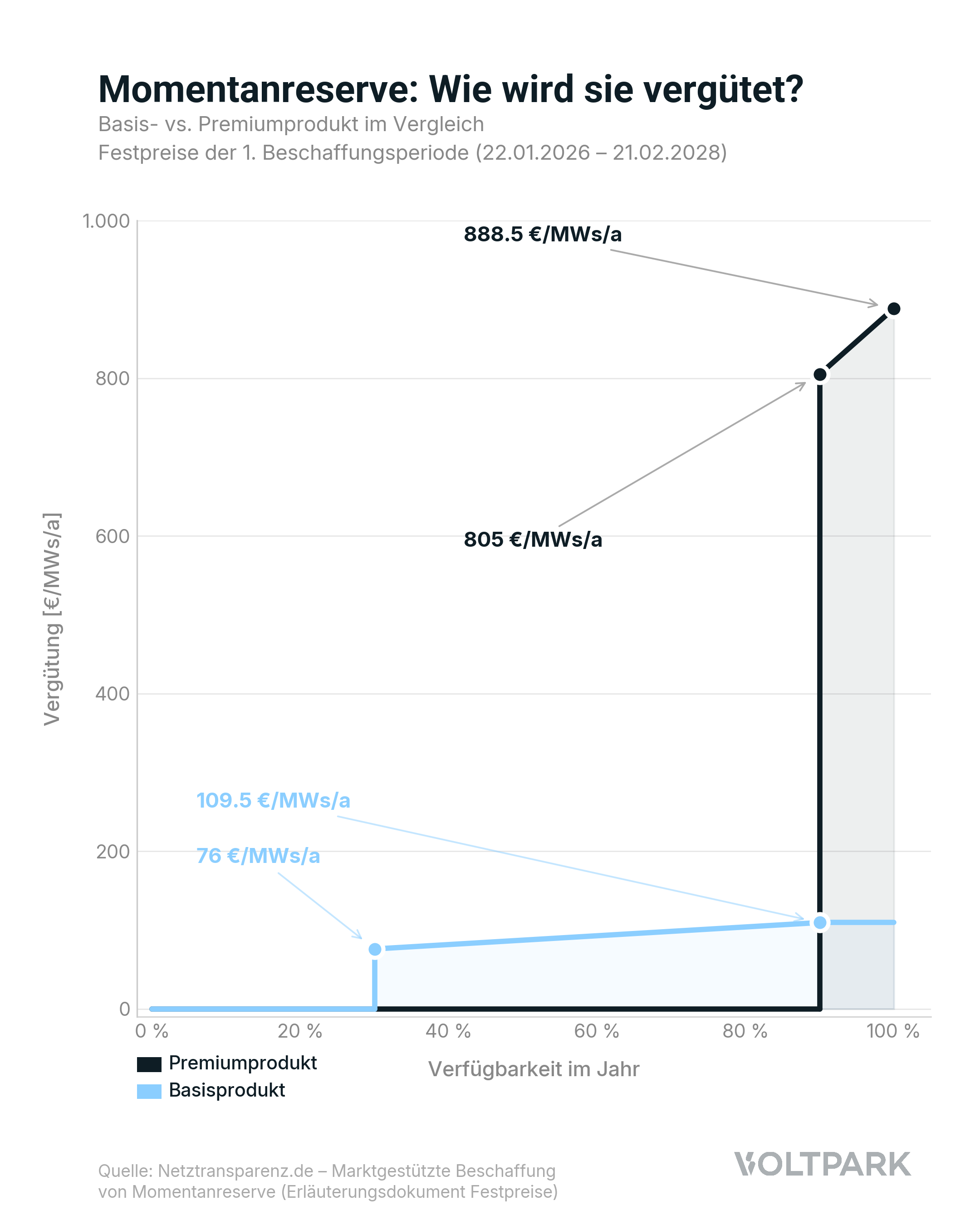
Depending on the product category, a battery storage system can currently generate approximately the following revenues:
Basic product: around €2,000 per MW per year
Premium product: up to €20,000 per MW per year
The product classes differ primarily in the required annual availability and thus in the quality of the system service provided.
While established markets like FCR respond to frequency deviations, instantaneous reserve addresses the very fast power provision in the millisecond range, which has so far been primarily provided by rotating generators.
Grid Forming as a Technical Design Decision
This raises a strategic question for developers and investors:
Is this market incentive sufficient to design storage systems as grid-forming capable by default in the future?
The technical design is not trivial. Participation in the instantaneous reserve market requires grid-forming capabilities as well as corresponding technical certifications. This can create additional requirements, such as:
- More powerful inverters
- Extended engineering
- Testing and validation
- Certification processes
Grid Forming thus becomes a deliberate design decision in project engineering.
Beyond Market Revenues
Fraunhofer IEE points out that Grid Forming Readiness could become relevant not only through market revenues in the long term.
A potential additional lever lies in the grid connection process. Systems with grid-supporting properties could in the future be qualitatively differentiated or given preferential treatment.
Should this logic become established, Grid Forming could in the long term become a kind of technical quality criterion for system-serving installations.
Conclusion
The energy transition is changing not only the generation structure but also the requirements for system stability. Battery storage systems are increasingly taking on tasks that conventional power plants previously fulfilled.
With the introduction of a market for instantaneous reserve, a clearly defined compensation mechanism for synthetic inertia is being created for the first time.
Whether this incentive is sufficient to broadly establish Grid Forming in the market remains open. What is already clear today:
The capability for grid forming is increasingly becoming a relevant design criterion for future storage projects.


